
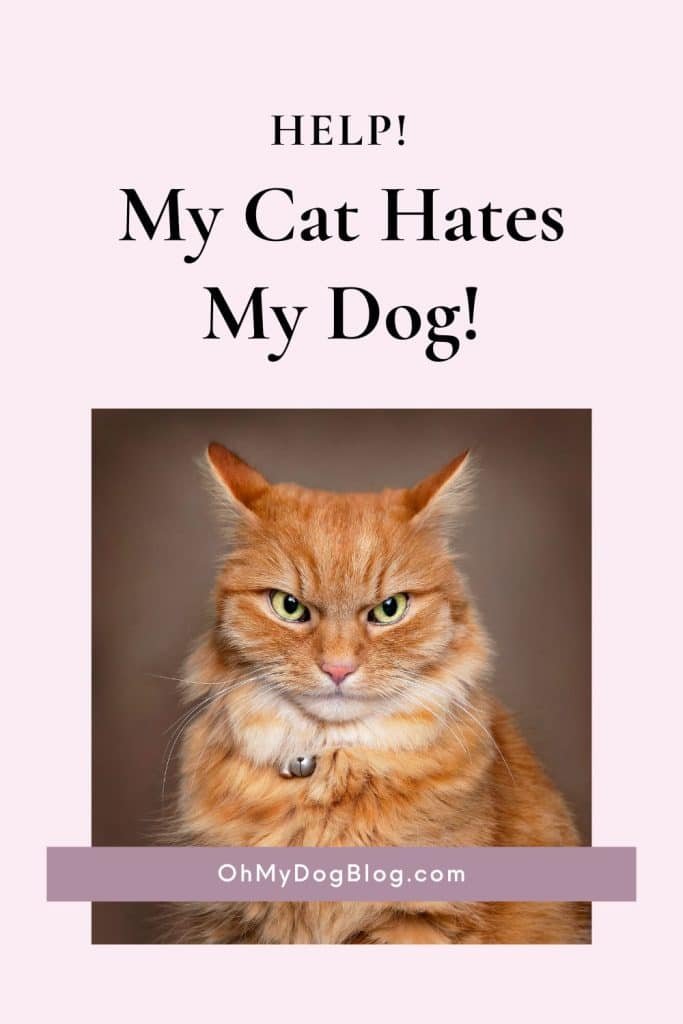
Ripley hates Stola.
Like, really hates her.
To be fair, she hated Penny when Penny was new, too.
But this is a whole different level. Antagonistic and kind of aggressive. So, today, I’m examining why it’s so different and sharing what we’re going to do about it.

As an Amazon Associate I earn from qualifying purchases.
First, a word about cat-dog relationships:
Portrayed as adversaries in popular media, you know the trope: Dogs are always chasing cats. Cats are always swatting dogs. But is this real life or just cartoons?
Probably both.
In our experience with animals over the past two decades, John and I have seen it all. In fact, we’ve already tackled this same issue but in reverse; Lucas hated Newt.
Some dogs do love to chase cats. Others don’t. Some cats hiss and swat if a dog dares look her way. Others don’t.
Much of it is personality dependent. Then, you mix in a combination of environmental factors, sprinkled with a bit of training (or lack thereof), and a whole bunch of miscommunication.
A crystal clear example is in the tail. A cat swishing her tail is not happy. Not at all. She’s trying to tell you she’s irritated. A dog, though? Generally speaking, a low, swishing tail indicates a happy pup.
You can see how they might struggle to find common ground.
That said, cats and dogs can form a beautiful bond and a strong, trusting relationship. I suspect part of the reason Ripley had a hard time with Penny and a now even-harder time with Stole is because of the deep bond she shared with Cooper.
The two were inseparable. They played and snuggled all day, and they slept curled around each other at night. I’m sure she grieved Cooper as we did and then considered Penny an interloper. She came around to Penny–not to the point of sleeping curled up with her but close. Now, rambunctious Stola has infiltrated her new-found peace.
That’s my theory, anyway.
Do cats really hate dogs?
My cat hates my dog, but generally? No.
In fact, most people I know who live in a multi-species home, the vast majority share their pets have a great relationship. The next largest group reports the animals have a mutual respect for each other but keep their distance. Only a small few–Ripley included–have a hostile relationship.
Plus, both cats and dogs are super smart mammals. They can figure out pretty quickly how to act around another mammal, even of another species, and respond accordingly.
Part of our problem is that Ripley hisses and growls at Stola, which Stola–since she is deaf–can not hear. So, Stola ignores the hissing and growling (ignores, according to Ripley, but the reality is she’s not hearing the warnings!) and that makes Ripley even angrier. Repeat a dozen times a day.
What to do if your cat doesn’t like your dog?
This, of course, is the boat we’re floating right now.
Stola can be perfectly calm and Ripley still swats her. So, we have a bit of a challenge ahead of us. I’m tackling this on two fronts: management and training.
Management
I have an entire post coming up soon on the importance of utilizing management as a strategy, but for now, here’s the gist: Management is the strategy to use to purposefully and proactively set up your environment to prevent the undesirable behavior. It’s not dog training at all; it’s used to prevent triggers in the first place.
So, what does that mean for us?
I’m striving to prevent Stola from approaching Ripley while allowing Ripley space to approach (if she wants) and escape (if she doesn’t).
What that looks like right now is a series of baby gates set up in the hallway to prevent Stola from reaching the stairs. Ripley has full reign upstairs for now. It also means a gate at the kitchen door to keep Stola from getting to the cat food and the cats’ water dish. (I really, really like this gate, btw, because it’s easy to open but VERY secure. If you want a more affordable choice, this is a great option, but you’ll be stepping over it a million times a day, which can be a hassle.)
We also have an X-pen set up in the corner of the living room. This is Stola’s fun place. She gets bully sticks or puzzle games to play when she’s closed in here. I bought an inexpensive machine-washable rug for underneath to keep the pen from sliding, and I can wash it after she enjoys a bone or food puzzle. (More on this in the upcoming “puppy survival” post!)
When Stola is in the X-pen doing her fun activities, it gives Ripley a chance to be out doing whatever she wants around the house without having to be hyper-vigilant. Plus, Stola get super excited for these special treats and even though she’s in a pen, she’s still among the family activities.
These two management strategies–the gates and the X-pen–keep everyone safe and secure without accidental interactions.
Training
Management is not training. It just helps your dog not make a bunch of mistakes while you are training.
Our training plan is simple.
First, we’re setting up purposeful training sessions. This looks like the cats on one side of the kitchen baby gate and Stola on the other. We dole out squeeze cheese as long as everyone stays calm. It works beautifully. My goal is to reward them for being cool customers next to each other to change Ripley’s response from “GO AWAY STOLA I HATE YOU THEREFORE I SHALL SMACK YOU” to “I get lots of cheese when Stola is around, and I loooooove cheese.”
Second, we’re rewarding Stola every single time we see her make an appropriate choice around one of the cats, not just Ripley. She sees Newt on the kitchen counter and plops into a sit? Reward! She sees Ripley on the other side of the gate but turns her head away? Reward! She sees either cat on the cat tree in the living room and doesn’t attempt to climb up it, too? Jackpot!
Yes, I always have my pockets stuffed full of treats all day every day, and yes, I always have to be vigilant, but it’ll be worth it in the long run.
Will my cat eventually like my dog?
Maybe.
Maybe not.
It would be ideal if Ripley someday liked Stola. But my bar isn’t set that high.
My goal is that they are tolerant and respectful of each other and each other’s boundaries. That means Stola stops chasing the cats. That means Ripley stops swatting Stola for simply existing in her presence.
Would I absolutely LOVE for Ripley to snuggle either Penny or Stola? Of course! But it’s unrealistic to set that as the end goal. Instead, we’re aiming for peace.
I think this plan will get us there.
If you’ve had a cat hate your dog, what steps did you take? How did you handle it? Please share in the comments so we can all learn from one another!

Grab a free copy of the book Positive Reinforcement Training for Dogs of ALL Abilities when you join my email community!